First Steps with Okodia
1. Company Overview
Welcome to the Okodia family!
We are certain you will enjoy an enriching professional experience working with us.
As a freelance translator, your contacts are the following:
- Vendor Manager (for the initial selection process and vendor set up in our company’s system)
- Project Managers (responsible for all translation project-related issues)
- Invoicing Managers (for any invoice or tax matters)
At Okodia we have created the Translators Knowledge Base as a way to compile all different information which may be useful for our translators (it may be updated from time to time to incorporate new information). For your convenience, the link to this portal will be present in all our project assignment emails.
ACTION REQUIRED: We need you to read this document now that you have been incorporated into our pool of translators, but also the rest of information in the Translators Knowledge Base, specially those articles in the ‘How to’ category related to using Plunet, finding the TMs/TBs, working with Groupshare, etc.
These articles contain key information related to the way we work. It is very important that you are already familiar with that information before you receive the first project assignment from us, so that everything goes smoothly from the beginning, in case of a tight deadline.
Also, during our collaboration, remember to check this area whenever you have a doubt related to our working processes. If your query is not explained, feel free to reach the relevant contact person listed above.
2. Main assignment categories for linguists
- Translation (aka Human translation): When commissioned for translation only, the Vendor shall provide a translation carried out by a professional human native-speaking translator, compliant with the industry best practice (See «Quality Expectations» on section 3 below) and generally accepted quality criteria for the type of service provided.
Focusing on the following elements is of the utmost importance to deliver a competent translation:
-
- Terminology: compliance with specific domain and client terminology, or any other terminology provided, as well as terminology consistency throughout the whole translation. You will be able to access the specific TM and TB from our Groupshare server once the Project Manager has assigned you the project.
- Grammar: syntax, spelling, punctuation, ortho-typography, diacritical marks.
- Lexis: lexical cohesion and phraseology.
- Style: compliance with the client’s style guide, including register and language variants, as well as other reference material provided. You might receive the Style Guide Instructions or other specific project instructions from the client from the Project Manager in charge of the project, if there are any to be followed. You will be able to check most of these instructions in Plunet and in the kick-off email, once jobs are assigned to you.
- Locale: local conventions and regional standards.
- Target group and purpose of the translation: Ensuring the target market requirements are met for the intended end-use/purpose of the translation.
- Track-changes translation (TC): Translation projects include track changes (TC) requests, which are particularly frequent for most of our biggest clients. One document is updated with track changes and its previous translation needs to be updated accordingly. You will find the relevant information regarding TC projects here.
- Back-Translation: Back-translations are reversed translations from the initial target language into the original source language (in most cases, they result in a back-translation from any language into English).
In order to fulfill its purpose, back-translations must be as literal as possible, and they may not always read fluently because its main purpose is not to be natural, but to be accurate and reproduce (to the best extent possible) the exact meaning in the language the document was initially translated into.
When commissioned for back-translation only, the Vendor shall provide a back-translation carried out by a professional human native-speaking translator, compliant with the industry best practice (See «Quality Expectations» on section 3 below) and generally accepted quality criteria for the type of service provided. In particular, the translator must review and edit his or her own work before submission. Additionally, if the translator spots any potential error worth mentioning while working on this request, it is expected to also share this information with the Project Manager, so the latter can double-check it later on and fix it if appropiate.
- TEP: When commissioned for TEP (translation/edit/proof), the Vendor shall provide a translation carried out by a professional human native-speaking translator, compliant with the industry best practice (See «Quality Expectations» on section 3 below) which has in addition been reviewed and proofread by a second native-speaking translator as per the service indicated just above. The service provided for TEP shall be compliant with ISO17100:2015.
Under “Translation, Track-changes translation, Back-Translation and TEP”, it is strictly forbidden to perform machine translations (with or without further review) and that only human professional translations are accepted, according to translation best practices. In case this instruction is not followed, the job shall not be paid and the linguist shall be immediately disqualified.
On completion of the initial translation, the translator must review and edit his or her own work before submission. This process shall include checking that the meaning has been conveyed, that there are no omissions or errors and that the defined service regulations have been met. (See «Quality Expectations» on section 3 below).
- Machine Translation Post-Edition (MTPE): When commissioned for Machine Translation Post-Edition, the Vendor shall correct the translation generated by a machine translation, which will be already provided by Okodia, so it meets the quality criteria indicated by Okodia under this Service according to the specifications in each job. The Project Manager in charge of the project will always indicate in the job whether the Vendor should perform Machine Translation Post-Edition Full or Machine Translation Post-Edition Light. In particular, the translator must review and edit his or her own work before submission. The specifications for each type of post-edition work are detailed below:
- Machine Translation Post-Edition Full (MTPE Full):
- Ensure that no information has been added or omitted;
- Modify all inappropriate content;
- Restructure sentences in case the meaning is incorrect or unclear;
- Generate grammatically, syntactically and semantically correct target language content;
- Respect the client’s terminology or domain;
- Apply spelling and punctuation rules;
- Ensure that the appropriate style is used for the type of text and that style instructions provided by the client are followed;
- Machine Translation Post-Edition Light (MTPE Light):
- Use the raw TA result as much as possible;
- Ensure that no information has been added or omitted;
- Modify all inappropriate content;
- Restructure sentences, in case the meaning is incorrect or unclear.
- Machine Translation Post-Edition Full (MTPE Full):
- Editing/Review: For the purposes of this Manual, editing/review is understood as the process of comparing the entire target text to the entire source text and reviewing for completeness, correctness, accuracy, consistency, terminology, adherence to instructions, glossary and style guide (if available) and language and punctuation, editing the text for style and fixing typos and other potential errors as needed to make it perfect. When editing/reviewing a document, pay special attention to the following:
- Reading the translation without comparing it to the source to quickly assess language quality.
- Comparing the translation to the source to review the accuracy of the translation, names, numbers, and potential missing text, editing the text for style and fixing typos and other potential errors as needed to make it perfect. Key aspects to check:
- Translation errors
- Omissions
- Mistranslations
- Inconsistencies
- Terminology inconsistencies (was there a glossary? was it respected?)
- Typefont inconsistencies
- Logo or trademark inconsistencies (should it be translated, repeated throughout the document or only once?)
- Measurements and Currencies (did the client request that they be localized?)
- Metric/Imperial system
- Currency conversions
- Grammatical errors
- Typographic errors
- Stylistic errors (the translation is accurate but could be phrased better)
- Reading the entire document for language, grammar, and punctuation errors checks.
- Conducting research, if necessary.
- Entering all edits and conducting a final check for spelling, etc.
- Proofreading: For the purposes of this Manual, proofreading is understood as the process in which a text is evaluated in a single language without comparing it to versions in other languages. The focus of this type of review is on checking the clarity, coherence, grammatical correctness, spelling, syntax, and style of the text in that specific language in order to ensure that the text is clear and free of errors in the language it is written in. When proofreading a document, pay special attention to the following:
- Grammar and Syntax: Ensure that the text adheres to the rules of the language, including correct verb conjugations, sentence structure, and subject-verb agreement.
- Spelling and Punctuation: Check for correct spelling of words, proper use of punctuation marks, and correct capitalization.
- Clarity and Coherence: Assess whether the text is clear and easy to understand. The ideas should flow logically, with smooth transitions between sentences and paragraphs.
- Style and Tone: Make sure the text’s style and tone are appropriate for its intended audience and purpose. This includes checking consistency in word choice, formality level, and voice (active vs. passive).
- Vocabulary and Word Choice: Verify that the words used are accurate and suitable for the context. Avoid redundancy, jargon (unless appropriate for the audience), and overly complex language that might confuse readers.
- Consistency: Ensure consistent use of terminology, formatting, and style throughout the text. This includes maintaining uniformity in headings, bullet points, and numbering.
- Readability: Evaluate the overall readability of the text. This includes sentence length, paragraph structure, and the use of headings or bullet points to break up dense text.
- Accuracy: Ensure that any factual information, dates, names, or figures presented in the text are correct.
For Editing/Review and for Proofreading, deliverables are files edited to incorporate suggested changes to remove any errors detected. Where the file format permits it, Editing/Review shall be carried out directly in the bilingual file. Where the file format does not permit it and for proofreading, it shall be carried out with suggested changes tracked.
If requested by Okodia, a feedback regarding the translation quality (spelling, grammar, adequacy, register, omissions, completeness, consistency, accuracy, etc.) shall be required.
- Transcription: Process of transcribing. In other words, the Vendor shall make a written copy of any audiovisual content with its corresponding timestamp guidelines by listening to it and writing into text form the exact wording the speaker uses.
- Linguistic QA: Linguistic QA is understood as the process of comparing a specified extract of the target text to the source text and reviewing for completeness, correctness, accuracy, consistency, terminology, adherence to instructions, glossary and style guide (if available) and language and punctuation and reporting any errors detected such that the translator can correct them.
Deliverable is a completed Linguistic QA report in the format request by Okodia.
- Reconciliation: This is usually part of the Quality Assurance process followed after a back-translation project: once both the original file and the back-translation are available, both are compared, and potential meaning and content errors or confusions may be spotted (and could be eventually fixed in a later step).
The Vendor shall compare the source material and the back-translated version and look for potential issues, such as confusing expressions, discrepancies in meaning or usage of wrong terminology (if the client requested the use of any glossary). Vendors shall compile all this information and send it to the Project Manager.
Deliverables shall be the document reconciled with all the relevant comments included in them and any other task-related documentation if relevant, such as a glossary or the source file if they need any sort of further adjustment. The format may be previously agreed with the Project Manager (i.e., the task may be performed by using the Comments feature from Word, or maybe by simply listing all issues in a document).
- Sworn/Certified Translation: When commissioned for sworn/certified translation only, the Vendor shall provide a translation carried out by a professional sworn translator (or certified translator, public notary, etc. according to the laws and rules of each country) and compliant with the industry best practice (See «Quality Expectations» on section 3 below). In particular, the translator must review and edit his or her own work before submission.
Deliverable is a completed sworn translation, signed and sealed accompanied by a sworn statement.
3. Quality Expectations
Depending on the client’s preference, your translation may be delivered directly to the client or sent to a Reviewer. No matter the steps following your work, we expect a high-quality delivery from your side. The Vendor is expected to deliver a service complying with industry best practice and generally accepted quality criteria for the type of service provided.
In particular, the Vendor must:
- Deliver a human professional native translation (except when MTPE is clearly and explicitly requested).
- Deliver a linguistically accurate translation which is stylistically appropriate for the target market/reader
- Ensure that terminology is correct and appropriate for the target domain
- Ensure that terminology is consistent across all files within a project and with any reference materials provided (glossary, termbase, translation memory, previous translations, website, software strings, etc.)
- Comply with all customer-specific and project-specific instructions given (including style guides, previous translations, query answers, customer reviewer corrections, etc.)
- Thoroughly review all of the files so that grammar, spelling and punctuation are 100% correct and all conventions of the target language are adhered to.
- Where CAT tools are used, provide bilingual files containing no tag errors and cleaned files containing no formatting errors
- Provide final cleaned files reproducing the layout and formatting of the source document.
Before delivering your translation, please check the following:
- The document is fully and accurately translated.
- The PM’s instructions have been followed (whether the document needs to be returned clean, unclean, translated with Wordfast, Trados, etc.).
- Styles and format have been preserved from the source document into the translated version (for example Internal styles, underlines, italics…).
- Tags and links should be respected (not deleted or modified, unless it’s a language requirement).
Client edits or concerns are not uncommon when it comes to translation. In most cases, the client simply has questions that can easily be answered. When such cases arise, the PM will inform you in detail regarding those concerns and how you can help us solve them.
- Have all instructions been followed? Check the PO and any email correspondence from the PM.
- Have you performed a spelling and grammar check?
- Have you double-checked the proper names within the document?
- Have you checked the numbers and any necessary measurement conversions, when required?
- Have you made sure your work contains no missing text?
- Have you removed any highlighted, special characters, or other features added you added while working to help you/for your use?
- Have you checked that all formatting instructions have been followed, if necessary?
- Have you performed the second reading of your job?
- Is your work in the correct format (i.e. Word, PowerPoint, etc.)? (check PO or e-mail for instructions)
- Has the email been addressed to the correct person(s)?
- Did you deliver the files via Plunet (or otherwise any other delivery option agreed with the PM)?
- Has the PM (or Plunet) acknowledged receipt of your delivery?
4. Translation process
Translators are assigned per project. Once assigned, the PM in charge will send you (within our Translation Management System, Plunet) the source document(s) prepared to work with your preferred translation software and the instructions to follow, such as the Translation Memory and Termbase to use, etc.
During the process, translators and PMs may communicate freely. The main goal is to remove any barriers, allowing translators to better understand the client’s needs. Feel free to contact us if you have any doubt or if something doesn’t make sense to you, we know adapting to the requirements of a new agency can be rough. Once your translation is complete, you should send it back to your PM as specified. Please always follow the instructions of your assigned PM.
5. Review process
If required by the client, once the translations are received by the PM, the review process will begin. The reviewer will get a copy of the source text and the translation to review. All necessary corrections should be made in the track-change mode for future reference and feedback.
6. CAT tools and software
Okodia encourages all our linguists to know and use CAT Tools since this represents a crucial advantage to any linguist. These programs will help you save time, enable consistency with past projects, and ultimately save our clients money, which in return will make them send more requests.
Regarding the software required: we do not have a compulsory CAT tool. In case you do not have a designed software installed, our PMs could prepare the documents for you to work with another program, Trados Studio, for example, or any other if it is compatible with translation memories (TM).
7. Purchase Order (PO)
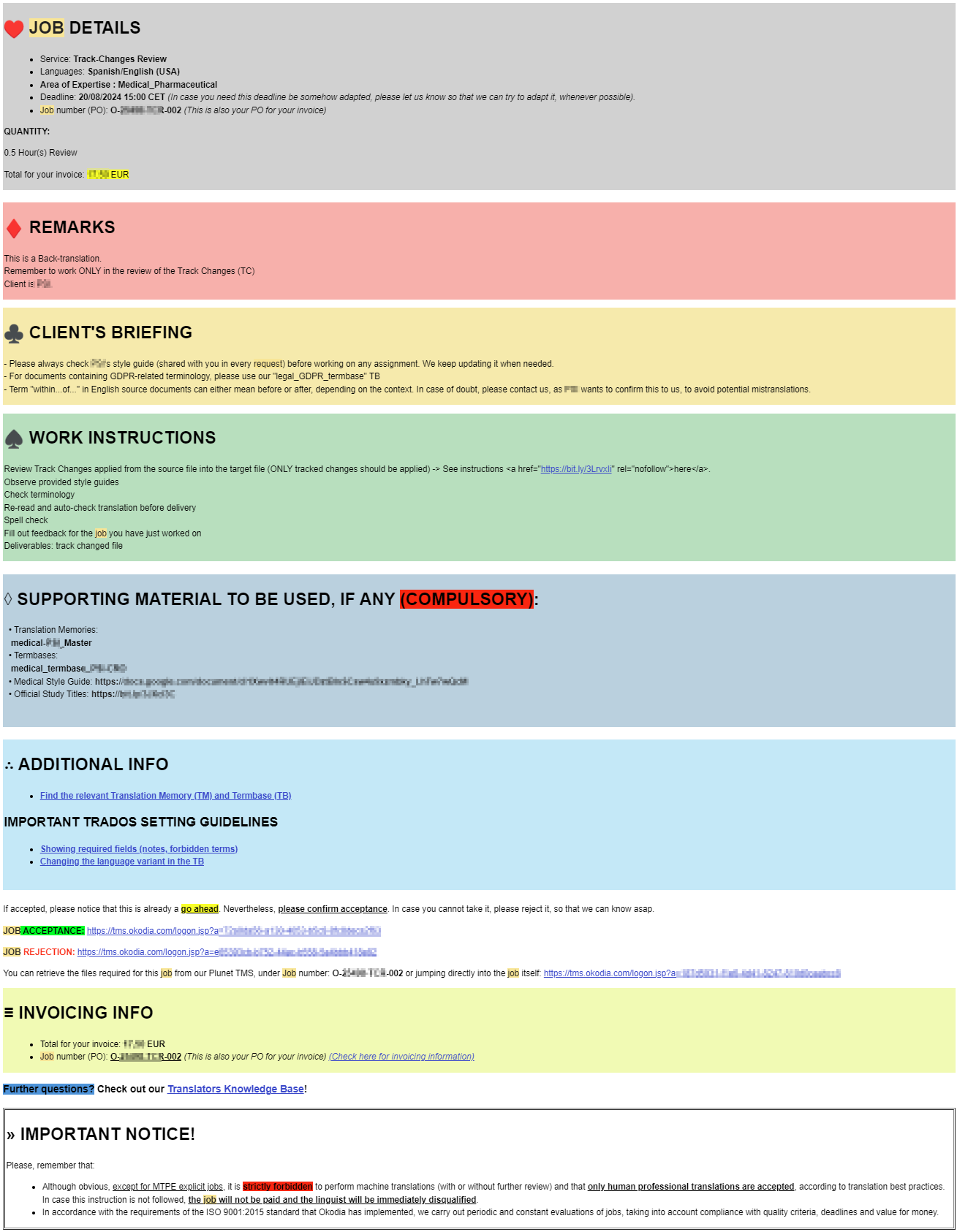
A PM may contact you before sending a job request in order to know about your availability, send heads up about a job or just discuss it in advance. A PM may also send a job request directly to you, without any previous information. Whichever the situation, you may expect a formal Assignment or Request email containing all the required instructions and other formal information, such as the PO number. Do not start working until you have accepted the job using the Acceptance link and the email indicates that such email is a go ahead. In urgent requests or impossibility to send such an email, you may start working ONLY if it has been clearly indicated that you can begin to work in order to save time and that PO will be sent shortly. Receiving an email inquiring about your availability, even if it includes the source document, does not mean that you have been chosen to complete the assignment. Please, carefully review the Request/Assignment (deadline, rate, instructions, etc.) and confirm the job with the Acceptance link. Alternatively you may also confirm with your PM that you have received all necessary documents to start working.
For reference, please find a Sample PO in Appendix A.
- The Purchase Order No. (PO) is how we identify each one of the assignments. Please, always include this number in your invoice.
- Timelines: The timelines given on the PO are based on the CET/CEST Time Zone. Deadlines MUST be met. If you think you might not be able to meet the deadline, please notify the PM immediately in order to discuss an alternative, if at all possible.
- Work Notes: Please always take note of the instructions on the PO. The PO also lists the person to whom you should return your job, usually, it will be the PM in charge.
8. Workflow process
After assessing the details of the project, the PM will contact you to know your availability to complete this corresponding task, or will send a direct job request to you, to accept or reject, depending on each case. When we offer you a project, you will receive an email with instructions and PO. Please accept or reject it directly by clicking on the corresponding link indicated therein, or within your Plunet area. Alternatively, you can also reply to that email and inform our PM whether you accept the job or not. Please take a look at Working with Plunet TMS. Once you have finished your task, you must deliver the relevant files via Plunet and you can also send an email (optional) to the PM who contacted you to let him/her know that you have completed the job. Please, use the email thread of that specific project to do so and click the option «Reply to all», since Okodia’s workflow process is based on working groups.
Please do not consider the job finished until you receive a confirming email from your PM.
In the event of not receiving confirmation after sending your work, remind your PM to confirm receipt. Please, do not simply forget about the project.
9. Invoicing
Once you have delivered your job, the PM in charge will take care of the QA process and will, in the end, approve the job. Once the job is approved, you may send the invoice for payment of the services rendered.
Please check the information related with the invoicing step here to make this process smooth.